
Geography
Hello, my name is Miss Mannion and I am the geography lead at Elms Farm. I love geography because I love to explore new places, travel and learn about different cultures. I have an interest in the natural world and enjoy finding out about the world’s natural events. I love teaching geography because every lesson is a doorway to the wider world. Geography blends curiosity, adventure and problem-solving. Teaching Geography means inspiring young learners to ask questions, notice patterns and care about the planet they call home. Geography is a way to spark wonder and help children understand their place in an amazing, ever-changing world.
Children at Elms Farm love geography. It is a chance to find out about their world in a fun and practical way. They have wonderful opportunities to explore their local area and beyond through fun and engaging field work. We start our fieldwork on the school grounds in EYFS. We look at the local area of Sheldon in year 2 and 3. Year 4 pupils visit Solihull town centre and Tanworth in Arden village. Year 5 pupils have the opportunity to visit Carding Mill Valley in Shropshire, which is on the Welsh border. These opportunities help to bring geography to life. Effective pedagogy in primary geography often involves experiential approaches, such as fieldwork and map work, which “support children in making sense of spatial relationships and environmental processes”(Geographical association) . Research also stresses the importance of linking geography to children’s lived experiences: “Children’s engagement with local environments provides a foundation for broader geographical understanding” (Geographical association)
Geography workshops
This November, we had geography workshops with our parents and carers. Parents have the opportunity to learn about what and how the children learn.
Geography at Elms Farm
In the Early Years Foundation Stage, geography is explored through children’s natural curiosity about the world around them. Through play, stories, and hands-on experiences, children learn about their immediate environment such as their home, school, and local community. They begin to notice features like buildings, parks, weather, and seasonal changes. They compare places, talk about journeys, and learn simple positional language. By observing, asking questions, and exploring outdoors, children start to understand their place in the world and develop early geographical thinking in a fun, meaningful way.
In Key Stage 1, the geography curriculum introduces children to the world around them by helping them develop simple geographical skills and knowledge. Pupils learn to identify the UK’s countries, capital cities, and surrounding seas, and compare their local area with other places in the world. They explore physical features such as beaches, forests, and weather. They look at human features like towns, offices, ports, and landmarks. Through maps, globes, and first-hand observations, children begin to understand location, direction, and basic geographical language. The aim is to build curiosity and awareness of their environment while laying strong foundations for future geographical learning. They begin to learn about the wider world by look at continents and oceans.
In Key Stage 2, the Geography curriculum deepens children’s understanding of the world by exploring a wider range of places, people, and environments. Pupils study the UK, Europe, and regions of the wider world including the USA, Brazil and Mexico. They develop knowledge of climate zones, biomes, and key physical processes such as rivers, mountains, volcanoes, and earthquakes. They learn how human activity shapes places, including land use, trade, and population patterns. Map skills are strengthened through the use of compasses, grid references, atlases, digital maps, and fieldwork. The aim is to help pupils think critically about how environments change and how people interact with them, fostering curiosity, global awareness, and responsible citizenship.
We offer opportunities for parents to get involved in our Geography workshops.
A high quality geography education should inspire in pupils a curiosity and fascination about the world that will remain with them for the rest of their lives.’ DfE (2013)
Aims of Primary Geography
-
Inspire curiosity and fascination about the world and its people that lasts a lifetime.
-
Develop knowledge of diverse places, people, resources, and environments at local, national, and global scales.
-
Understand key physical and human processes, such as weather, rivers, settlements, and trade.
-
Build geographical skills including map reading, fieldwork, observation, and data interpretation.
-
Recognise how physical and human features are interconnected and how they change over time.
-
Encourage awareness of environmental issues and responsibility for sustainable futures.
-
Connect learning to children’s own experiences, helping them understand their local area before expanding to the wider world.
These aims ensure that geography is not just about memorising facts, but about developing critical thinking, enquiry skills, and a sense of global citizenship.
Learning Journey
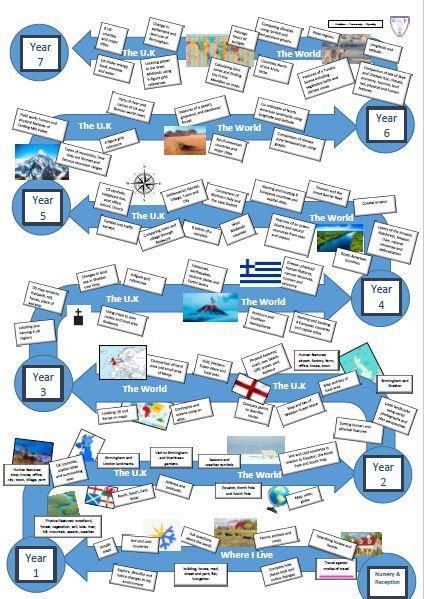
Whole School Geography Learning Journey
Pupil comments
The children at Elms farm have a good understanding of what they learn in Geography.
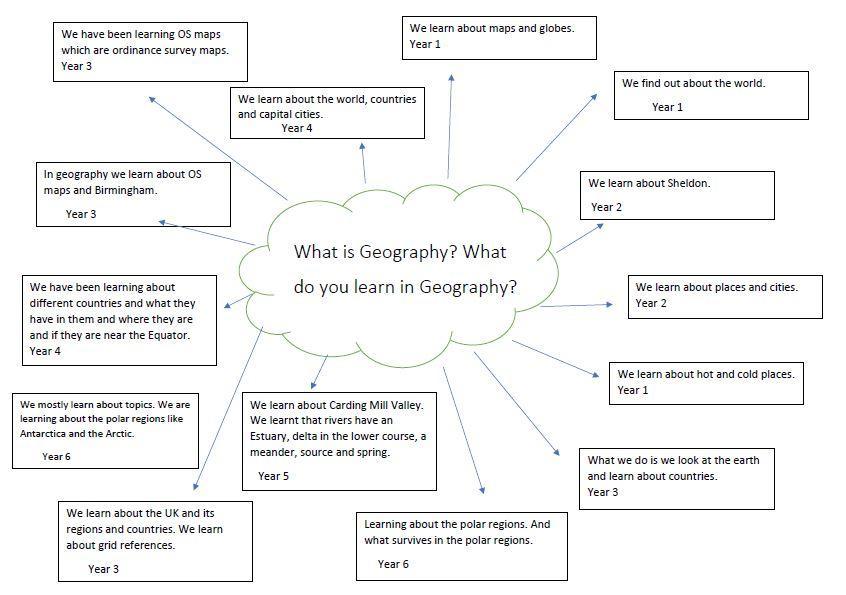
Click the link below to see some of the children's comments.
- Pupil comments
-
Geography National Curriculum KS1 and KS2